MADERA COUNTY, CA – Madera County residents may have noticed changes to their waste collection service as the county rolled out organic waste recycling programs in 2025, in compliance with California Senate Bill 1383, a statewide law aimed at significantly reducing organic material sent to landfills and increasing food recovery.
The law, passed in 2016 and authored by Senator Ricardo Lara, targets one of the largest contributors to climate change in the waste stream: organic waste. When food scraps, yard debris, and other biodegradable materials decompose in landfills, they produce methane, a potent greenhouse gas. SB 1383 sets ambitious goals to address this issue, including a 75 percent reduction in organic waste disposal and a 20 percent increase in the recovery of edible food for human consumption by 2025.
County officials say Madera has “gone green” by expanding organic collection and recycling services across multiple communities. Organic waste, sometimes referred to as compost or organic recycling, includes a wide range of materials such as food scraps, yard trimmings, grass clippings, landscape and pruning waste, untreated lumber and wood, organic textiles and carpets, food-soiled paper products, printing and writing paper, manure, biosolids, and similar materials.
At the same time, residents are reminded that certain items do not belong in organic bins. Prohibited materials include glass, plastics, metals, liquids, hazardous waste, and anything that should instead go into trash or traditional recycling containers. Waste haulers have been increasing monitoring efforts, and if prohibited items are found in an organic bin, customers may receive a warning tag as a notice to correct sorting practices.
SB 1383 requires every city and county in California to provide organic waste collection services to both residents and businesses. While some Madera County communities already have curbside green waste or food scrap collection programs, others are in the process of adding or expanding service to meet state requirements.
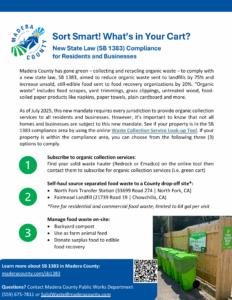
Starting last July, all property owners located within Madera County’s SB 1383 compliance area are required to participate. County officials emphasize, however, that not every address in Madera County falls within a compliance area at this time, making it important for residents and business owners to verify their status.
The county offers a Solid Waste Lookup Tool on its website where users can enter an address to determine whether it is located inside a compliance area. If the address is outside the area, the tool will indicate that the property is not within an SB 1383 compliance zone. For those inside the compliance area, the county outlines three primary ways to comply with the law.
While specific options can vary depending on location and service provider, compliance methods generally include subscribing to organic waste collection service, self-hauling organic material to an approved facility, or managing organic waste through approved on-site methods such as composting or anaerobic digestion. Additional details are available through the county’s “How to Comply” informational flyer.
In addition to residential requirements, SB 1383 also places obligations on certain businesses, particularly food-generating businesses, to arrange for the donation of edible food that would otherwise go to waste. The goal is to redirect surplus food to food banks, shelters, and other recovery organizations, helping address food insecurity while reducing landfill disposal.
County officials acknowledge that changes to waste sorting habits can feel overwhelming at first, but stress that the program is designed to be straightforward and educational rather than punitive. Early monitoring efforts are focused primarily on outreach and warnings, giving customers time to adjust.
Local waste and recycling staff encourage residents to take a few moments to learn what belongs in each bin and to reach out with questions. Educational resources, printable guides, and contact information are available through Madera County’s Solid Waste and Recycling webpage.
As California moves toward its climate and sustainability targets, Madera County’s implementation of SB 1383 represents a significant shift in how everyday waste is handled. Officials say participation from households and businesses will be essential to meeting state goals and creating long-term environmental benefits for the region.
For more information about SB 1383, compliance requirements, or to check an address using the Solid Waste Lookup Tool, residents can visit the Madera County website.
Madera County Economic Forecast: Gaming, Housing, Retail In The Pipeline